Tự Tân Huỳnh / Thân Khai Tâm
The Moment of Letting Go
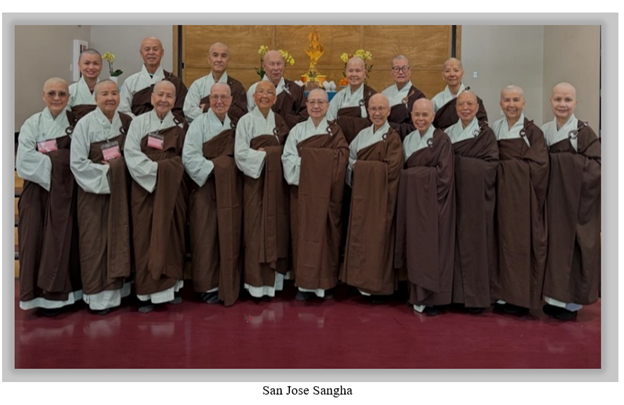
When the last lock of hair fell, I did not burst into tears like some of the other sisters had experienced. Instead, my face flushed red. I knew it because I felt my face becoming hot. Others thought I looked like I had high blood pressure or some health issue! One sister quietly asked, “Are you okay?” — “Yes, I’m fine.” At that moment, I felt something indescribable: letting go of something I once thought was very difficult. I had passed the first gate on this journey of altruistic ordination.
A Late Arrival… But Never Too Late
At times I wondered whether my fellow practitioners questioned why I had studied Master Hằng Trường’s teachings for over a decade yet was only now ordaining for the first time. It might seem like such a long wait! I never said it, and they never asked me directly, but one thing is certain: I never missed any of the Master’s Zoom teachings and had memorized all the mantras he taught.
Even so, I had been preparing myself for the day I would be ready to follow in the footsteps of my senior brothers and sisters. I believe the compassionate Master always forgives and understands the obstacles that slowed my progress. Still, I believe that even if the right conditions come late, having them is better than not at all.
Spiritual Companionship and Care
Reflecting on my experience during this ordination period, I recall a series of teachings by the Master on “Living Together, Practicing Together, and Working Together.” There were 100 lectures on this topic, filling over hundreds of pages of notes. The Master understood the capacities, personalities, abilities, and levels of cultivation of each disciple, and over many years taught how to live and practice harmoniously whether during short-term ordination or other retreats.
When it comes to spiritual friendship and care, I deeply felt it during this journey. Some senior practitioners did not take the bus like most of us but drove their own cars. With this convenience, they generated Bodhicitta and helped elderly or physically weak practitioners by driving them daily between their lodging and the meditation hall, and also during the three days of the Dharma assembly between the hotel and the Anaheim Convention Center. Those who received such care were surely moved and will always remember these noble acts and generous hearts, true “bodhisattvas in everyday life” who supported the elders so they could fulfill their aspiration of ordination.
The Master taught that a good spiritual friend is even more valuable than a good ordinary friend because they help us on the spiritual path. This proved true. I received care from my senior brothers and sisters—and sometimes unexpected care! During the first two days, I felt tense and awkward, not yet used to wearing the robes properly. I was reminded whenever the hem of the sash touched the ground, and I struggled with how to drape and fold the sash quickly like the others. My group leader said this was part of maintaining the dignified conduct of a novice nun.
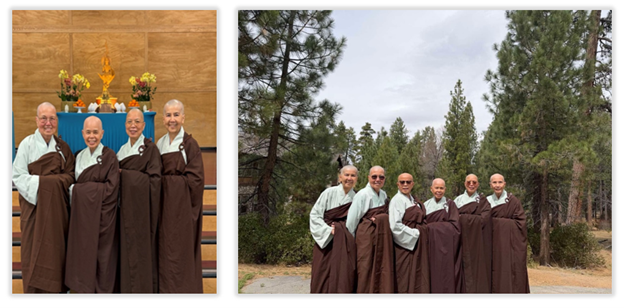
This dignity extended to walking to and from the meditation hall and dining hall—always wearing the robe and sash properly, carrying the sitting cloth over the left arm, and keeping everything neat, even when leaving before dawn or returning late at night. I also believed that, dressed in robes and sashes and walking through the quiet darkness, we were always protected
What We Did During the Three-Day-Dharma Assembly
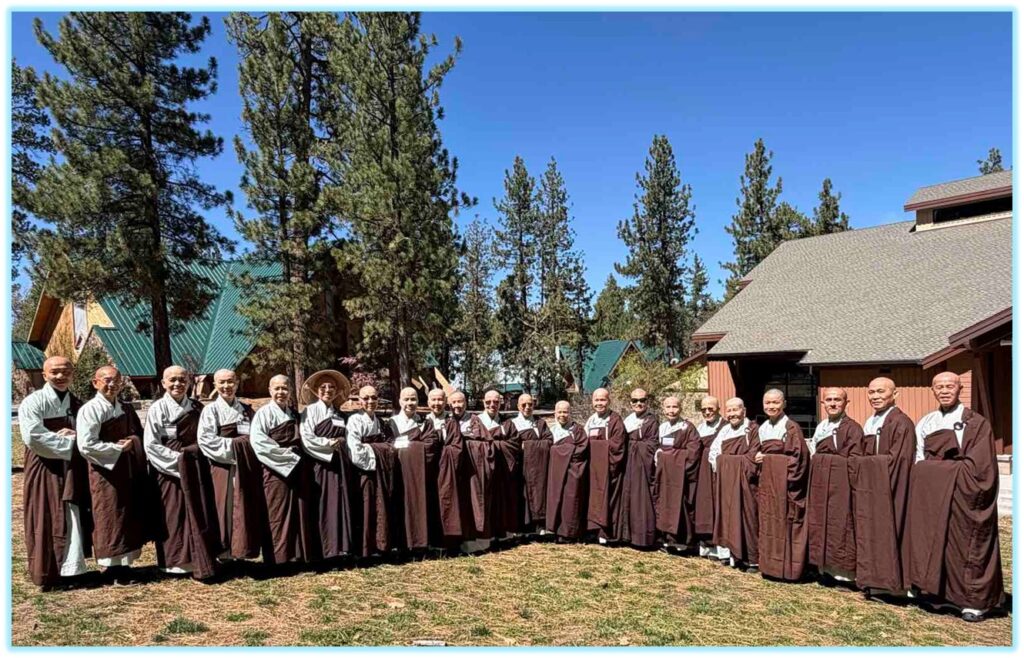
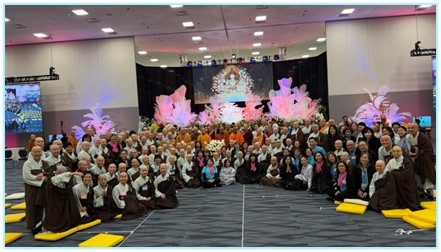
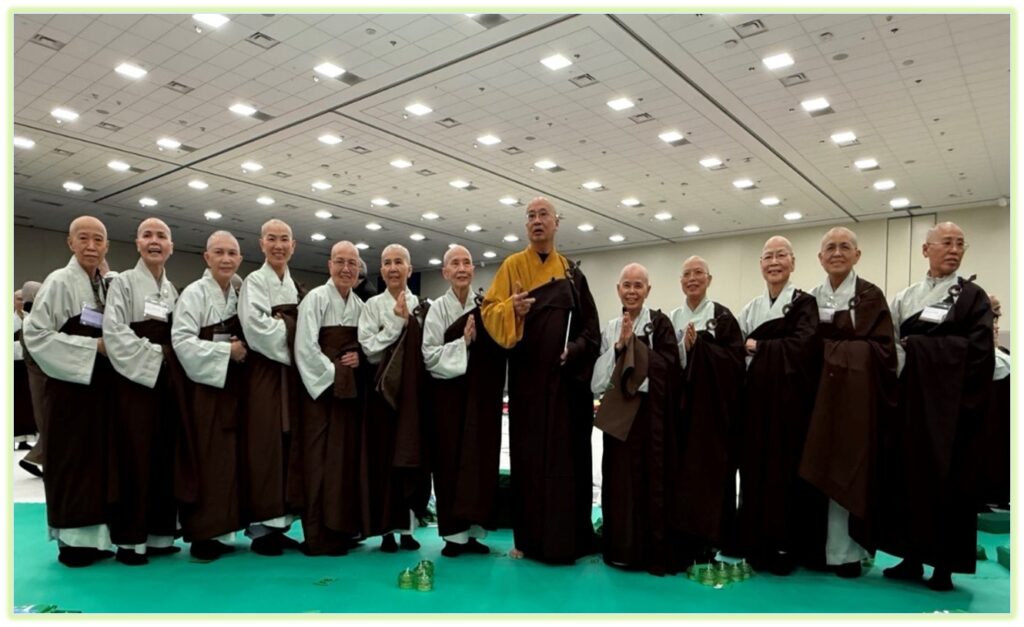
A week of practice in the mountains passed quickly. Just as I became accustomed to the schedule and felt grateful for the opportunity to learn these precious teachings, it was time to descend and re-enter the world on Thursday afternoon. We then headed to the Anaheim Convention Center for the World Peace Gathering 2026, held from April 3 to April 6.
After checking into the hotel, we walked to the convention center for dinner. The altar in the hall was beautifully decorated with lotus imagery. The next morning, practice continued at 6 a.m. At 8:30 a.m., we performed “three steps, one bow,” and many attendees joined in behind the monastic community.
Prostrating in such a solemn, clean, and safe space at the convention center was special and only possible under the guidance of the Master and the ushers. Everyone seemed sincere, carrying memorial tablets for prayers for the deceased and for the well-being of loved ones. Each bow felt like an offering to Avalokiteśvara and Samantabhadra, dedicated to all beings in one’s karmic network.
After the Master taught the mantra of the “Precious Conch” Dharma, including how to chant and sing it, we in the monastic group interacted with attendees and helped them learn it. Many said the teaching was precious and that singing made it easier to remember. One person told me, “Worldly happiness is so short-lived. Suffering is abundant—we get used to it, it passes, and we forget.” They said they attend every year when the Master holds the assembly. I felt this was a fortunate karmic connection—that they encountered these teachings.
I remembered the key words the Master emphasized: Open the bodhi mind and continue to give whenever you can, even the smallest things. So instead of resting at noon, I volunteered to guide people in writing seed syllables. Having learned calligraphy as a child, I felt capable. When asked what the Chinese characters were, I proudly explained that only those with blessings can encounter and learn them. These are “siddhams,” seeds of infinite light. Writing, remembering, and contemplating them connects us with the light of countless Buddhas and sages. People were delighted.
I believe in this deeply, which is why I strive to memorize the mantras taught by the Master. When he teaches them like songs, they are even easier to remember. His teachings are profoundly deep—rare and precious—and we are fortunate to meet such an enlightened teacher.
On the day of the precepts-release ceremony, the Master said: “Return the alms bowl, the precept sash, and the sitting cloth to the Buddha, and go back to the secular world. The time of practice has passed quickly and has now been completed perfectly. You are about to return, bringing with you what you have learned, to continue living well and continuing your practice.”
When I returned home, I touched my head—my hair had not yet grown back—and I felt a light, floating sensation, as if I were still a novice nun.
On this same day, I was unexpectedly shown a small tip by Dharma Sister Tuyết Ngọc Hồ: how to fold the precept sash very quickly (hold the label as the key point, fold it in half, then into quarters), and then neatly and skillfully place it inside the sitting cloth to store in the bag. Only then did I realize she was from my hometown of Nha Trang in Vietnam—we had met before at a retreat in Dallas in 2013, yet I hadn’t recognized her even though she was sitting right next to me.
Thank you so much, Sister. I hope that anyone attending their first Altruistic Ordination can read this and learn how to fold and store the sash this way.
My Teacher – The Spiritual Ferryman
In school, teachers are often likened to ferrymen carrying students across the river of knowledge. But when life becomes unstable or filled with despair, without spiritual grounding, how can one recover? True faith—not blind faith—brings balance to life.
Master Hằng Trường is that spiritual ferryman, guiding us toward peace of body and mind. He teaches the profound Dharma of the Avatamsaka Sutra and the Bodhisattva path, both in Transcending Worldliness (meditation and practice) and in Engaging with the World (living, interacting with others). The Compassionate Service Society is a spiritual refuge for disciples and their families, especially for the elderly.
Faith – The Energy That Nourishes the Soul
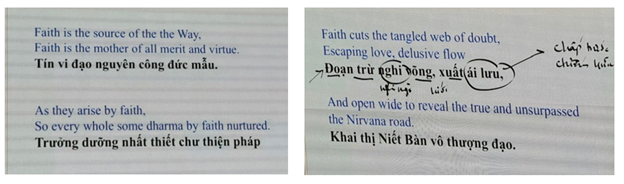
During this year’s Selfless Renunciation and Mandala Dharma Assembly, a special event took place: for the first time in the program, there was a hymn titled: Avatamsaka Hymn of Faith (Faith is the Source of the Way) was performed during the Mandala Night. It was composed by Mr. Paul Hopp (also known as Hằng Kỳ, a Dharma brother of the Master).
The hymn was professionally recorded and performed with deep emotion. We had learned it days earlier, and hearing it at the assembly felt transcendent like the music came from the Heavens. Not only were spirits guided onward by its sound, but participants also felt joy and upliftment.

This innovation showed that Buddhism is not limited to bells and chanting but can include spiritual music. The song is now available on YouTube for wider audiences. Beyond fame, wealth, and health, faith is essential for life at any age.
Deep Gratitude
In closing, I wish to share this: if you have spiritual aspirations or wish to ordain but face obstacles, pray sincerely to Venerable Master Hsuan Hua. He is compassionate and responsive and will create favorable conditions. With faith, you will witness the miraculous.
I respectfully thank the Buddhas, Bodhisattvas, Avalokiteśvara, Samantabhadra, Dharma protectors, and unseen beings for safeguarding our practice and ensuring the success of the Dharma assembly.
I am profoundly grateful to the Master for continually teaching us how to live a truly meaningful life. He constantly embraces and applies modern technologies and skillful means to make his teachings easier to understand. Thanks to this, all disciples are able to progress on the spiritual path, even those living far away can continue to learn and practice. With boundless compassion, the Master has passed on everything he has received, guiding his disciples and all beings toward the shore of enlightenment and helping them avoid becoming entangled in trivial worldly matters.
From the bottom of our hearts, we are deeply thankful to those who created the Compassionate Service Society App (tubiphungsuapp.com), preserving the Master’s teachings so that anyone who has the opportunity to access them can learn as if being taught directly by him. Being able to study and listen to his teachings repeatedly, each one is excellent and always conveys profound wisdom. With infinite compassion, the Master has transmitted what he has learned, leading disciples and all beings to the path of awakening and helping them avoid being caught up in insignificant concerns.
Finally, I sincerely thank the organizing team, fellow practitioners, the Bodhisattva Dharma Protectors, and my family for their support during my first “Altruistic Ordination.” It was a wonderful and unforgettable experience in my life—one that I will always treasure as something truly precious.