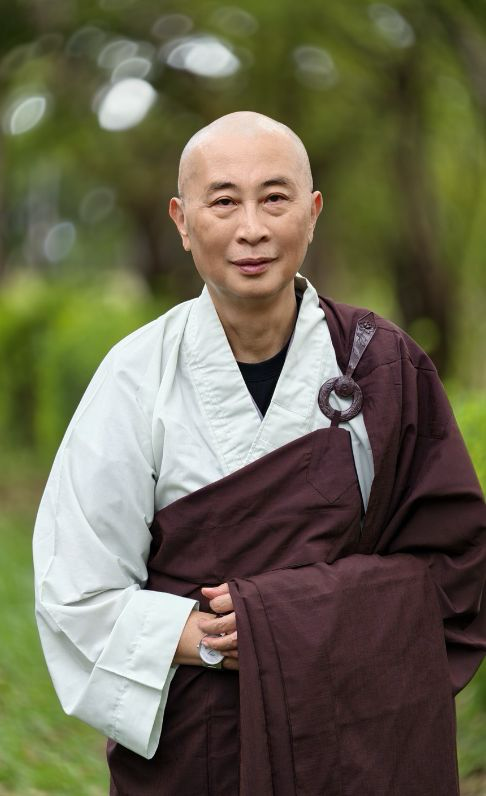
Eric Tu / Than Khai Nguyen Tung (親開元松)
My name is Eric Tu. I was born in Changhua (彰化), a city in central Taiwan. After completing my military service, I worked for a company in Kaohsiung, where I have since settled, lived, and raised a family, remaining here to this day.
This year marks the second year that my wife and I have participated in the Altruistic Short-Term Home-Leaving Retreat under the guidance of Master Hang Truong. Looking back, I realize that this decision was not merely about attending a retreat; it was the first step on a path that has led me to profound transformation in many aspects of my life.
Last year, shortly after retiring following more than forty years of diligent work, I suddenly became aware of a vast emptiness within myself. For decades, I had been running after responsibilities and obligations—things I “had to do”—without ever stopping to ask what I truly needed or what my life’s ideals really were. When the pace of life finally slowed, I could clearly see how exhaustion had quietly accumulated in both body and mind over the years.
On the surface, retirement life appeared calm and ordinary. Yet inwardly, I felt a deep sense of stagnation and imbalance: no clear direction, no spiritual anchor. I understood that if I did not change, I would continue living in that familiar cycle—materially complete yet inwardly empty, leisurely yet devoid of true peace.
It was during this period of stillness that I began to practice with greater maturity and mindfulness. Previously, my wife and I had the good fortune to study the Dharma with Master Hang Truong. We listened to many teachings and understood the methods of practice, but due to the busyness of daily life, our actual practice was neither consistent nor deep. After retirement, I began practicing every day with greater diligence and seriousness. Gradually, I realized that these teachings were not abstract theories at all, but very practical methods for evolving the mind and opening the spiritual path.
In addition, Master taught me to apply a new concept called the “Reversal Concept.” This approach trains one to think and act in ways opposite to long-established worldly habits. Through practicing this method, I came to see just how deeply entrenched I had been in secular conditioning. From the smallest daily routines to major life decisions, everything had been governed by old patterns.
At first, this “reversal” was not easy. It felt like learning to walk again—slow, awkward, yet requiring perseverance and patience. The most essential task was to establish new habits. If I had not previously recited mantras or meditated daily, I now needed to practice consistently and treat it as a natural part of life. This steady practice opened my eyes to many things I had never seen before: hidden anger, unconscious cravings, nameless fears that had quietly influenced me all along. Once I recognized them, I no longer felt irritated or distressed. I simply acknowledged them calmly, knowing they were long-standing latent tendencies.
Through this, I came to understand that cultivation is not something lofty or mystical; it is the gradual transformation of everyday life. Each time I choose a more wholesome thought, or an action that benefits others rather than serving my own pleasure, I take another step on the path of transformation. For this reason, donning the form of an ordained practitioner—even for just ten days—became an extremely precious experience. It felt like a clear affirmation that I had truly embarked on the journey of transformation.
After a year of practice, I clearly sensed changes within myself. Old frustrations gradually subsided, and fatigue no longer weighed so heavily upon me. Rigid, judgment-laden views softened as the grip of ego loosened. In their place arose gentleness, stability, a simple and quiet joy, and a balanced perspective I had never known before. I understood that this did not arise naturally on its own, but was the fruit of practice rooted in last year’s ordination aspiration.
This year, I renewed my vow to undertake ordination with a deeper intention: to dedicate the merit to my mother, who recently passed away. I vowed to devote myself fully to practice, praying and transferring merit to my beloved mother. Last year’s participation in the Mandala practice helped me realize that this method of cultivation can assist departed beings toward liberation through the vows of the Buddhas and Bodhisattvas, together with the sincere collective practice of the community, including the Altruistic Short-Term Home-Leaving Sangha. To me, filial piety is not merely words or tears; it is devoted practice—offering one’s time and effort to transform oneself. I believe there is no gift more sacred than dedicating one’s genuine cultivation to one’s parents.
Looking back, I now see that the experience of shaving my head for the first time was a vivid demonstration of the “Reversal Concept” taught by Master. Ordinarily, I believed hair to be an important part of one’s appearance—something tied to confidence and difficult to let go of. Yet when the blade touched my scalp, I felt light and at ease, as if an invisible attachment had just been removed. Just hours earlier, the image of a shaved head had made me hesitant; after the shaving, it felt completely natural, nothing at all to worry about.
This was reversal: reversing notions of beauty, reversing attachment to form, reversing the fear of losing a part of the “self.” Through this, I understood more deeply that cultivation is not only about changing ideas, but also about daring to enter experiences that reveal the ego—things theory alone can never reach.
Becoming a member of the Altruistic Short-Term Home-Leaving Sangha itself represents a profound reversal in many aspects—from worldview to lifestyle. It is a reversal in perspective: instead of seeking outwardly, I learn to turn inward and see myself clearly. It is also a reversal in way of life: from worldly comforts and habits, I learn to live more simply and purely by upholding the rules and precepts of ordained life.
Through Master’s guidance, I came to understand that nothing in this world is truly that serious. What makes things heavy is our own grasping and attachment. As I practiced reversing this habit—clinging less, demanding less, holding less—everything became much lighter. My temper noticeably softened, and the people who feel that change most deeply are the family members and friends.
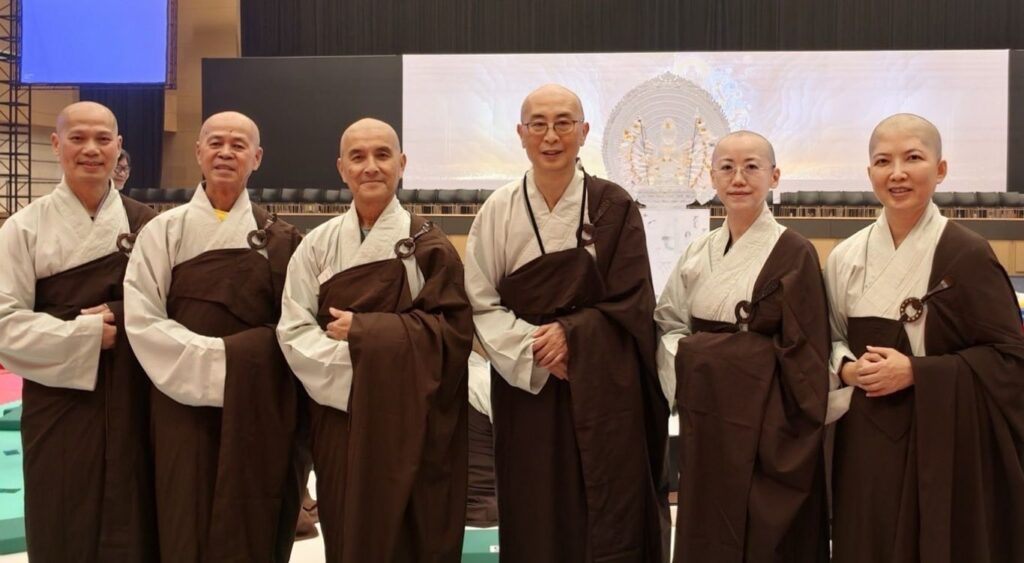
The Altruistic Short-Term Home-Leaving Retreat left a deep impression on me regarding monastic life and the Sangha’s spirit of service. What moved me most was everyone’s clear understanding that the collective benefit always comes before individual interest. The Sangha is not merely a group of people practicing together, but a community living in harmony, empathy, and mutual support on the path of transformation.
Through practicing the “Reversal Concept,” I noticed that my relationships with others naturally became more harmonious. Instead of reacting according to old habits—blame, irritation, or holding onto minor grievances—I learned to see the difficulties in others’ circumstances and habits. Once I could see that, accepting their shortcomings became easier, and compassion arose naturally, as if I were learning to look honestly at my own weaknesses and habitual tendencies.
Reflecting on this, I see that this spirit is a living expression of the “Reversal Concept.” Instead of placing the ego first—as worldly habits often lead us to do—each member of the Sangha chooses the opposite: letting go of self for the sake of collective peace. A very concrete example occurred yesterday. Most novice monks and nuns were assigned to construct a mandala, but due to unforeseen circumstances, the work had to be postponed until today. Despite the long wait, no one complained or showed irritation. Everyone maintained gentleness, patience, and a spirit of service. Rather than reacting through old habitual tendencies—impatience, frustration, or blame—everyone chose reversal: acceptance, letting go, and continued service with a peaceful mind. No one allowed the delay to disturb their heart or the calm, sacred atmosphere of the Dharma assembly.

Through two years of practicing altruistic ordination, I now see clearly that this path has not only helped me rediscover an inherent peace, but has also opened a new direction for the remainder of my life. From a vast emptiness after retirement, I have found a new source of vitality—a life ideal to rely upon, a community to walk with, and a path for transforming body and mind. I am deeply grateful to Master, grateful to the Sangha, and grateful to my wife—who has always accompanied and supported me as I stepped out of old habits and into the path of practice, into the journey of transformation.