Bích Ngô – Dharma Name: Thân Mỹ Khiêm
A Decision Arising from an Unexpected Karmic Affinity
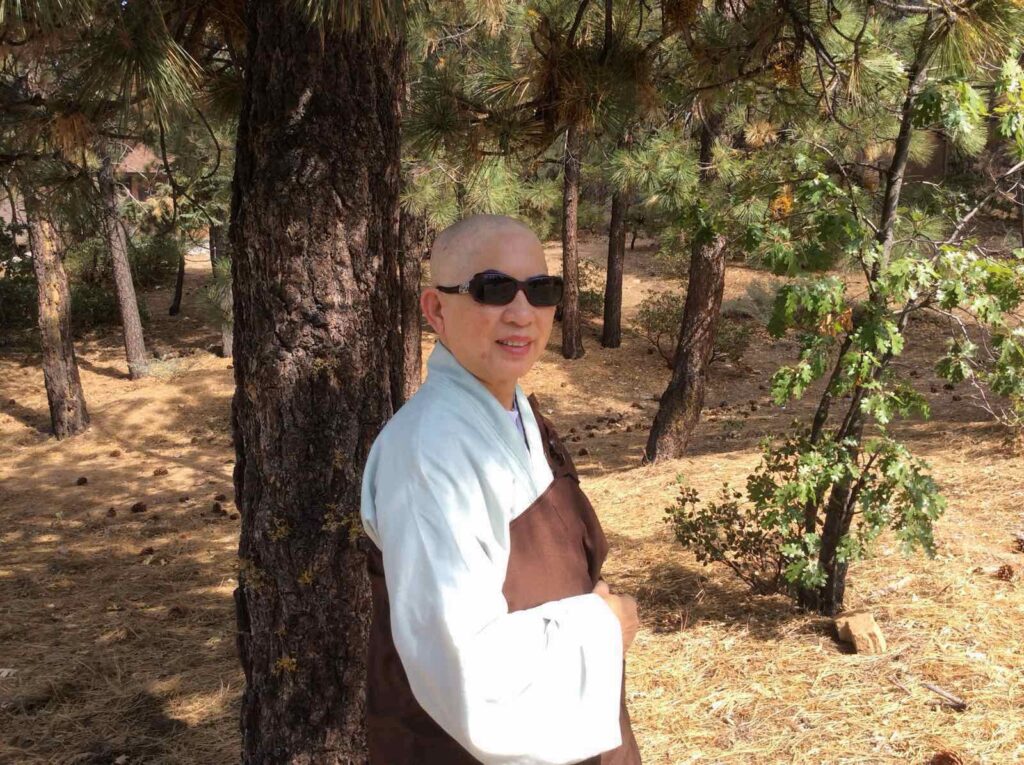
My name is Ngô Bích, Dharma name Thân Mỹ Khiêm. I currently live in Orange County, California. I have participated in the Altruistic Home Leaving program since 2014, and the karmic affinity that brought me to ordain that year was very special. That year, I registered for the Bồ Tát Hộ Pháp (BTHP / Dharma Protector) program and made all the necessary preparations, simply waiting for the day of departure. However, everything changed completely, far beyond anything I had anticipated.
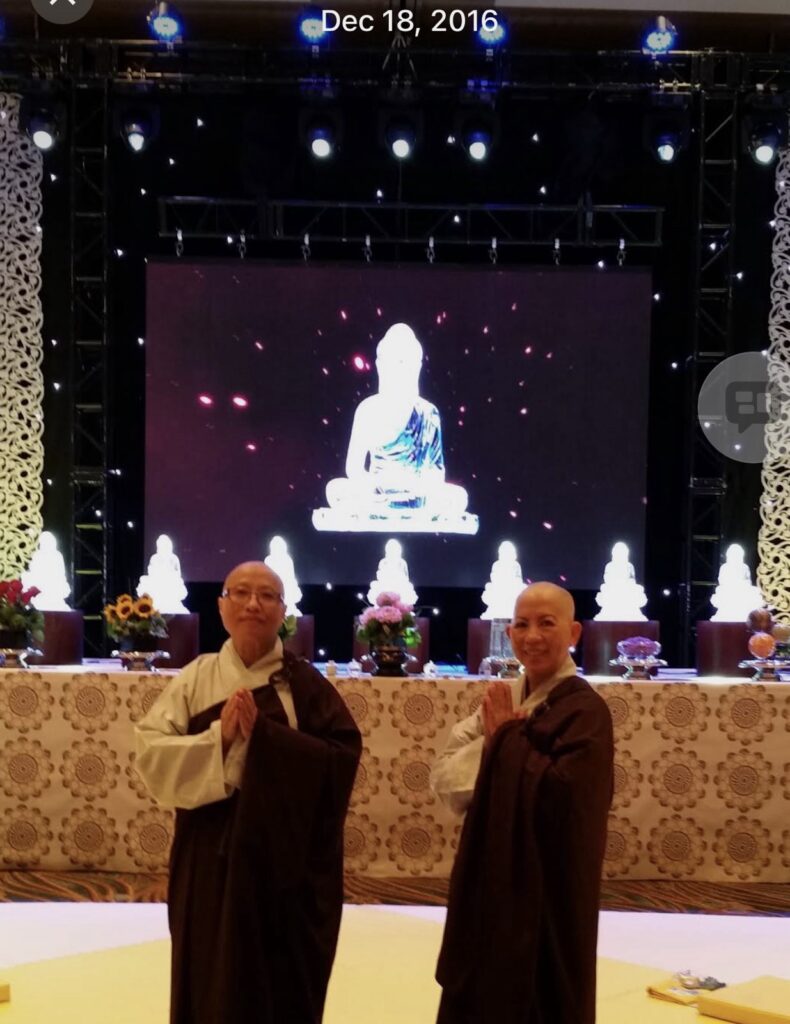
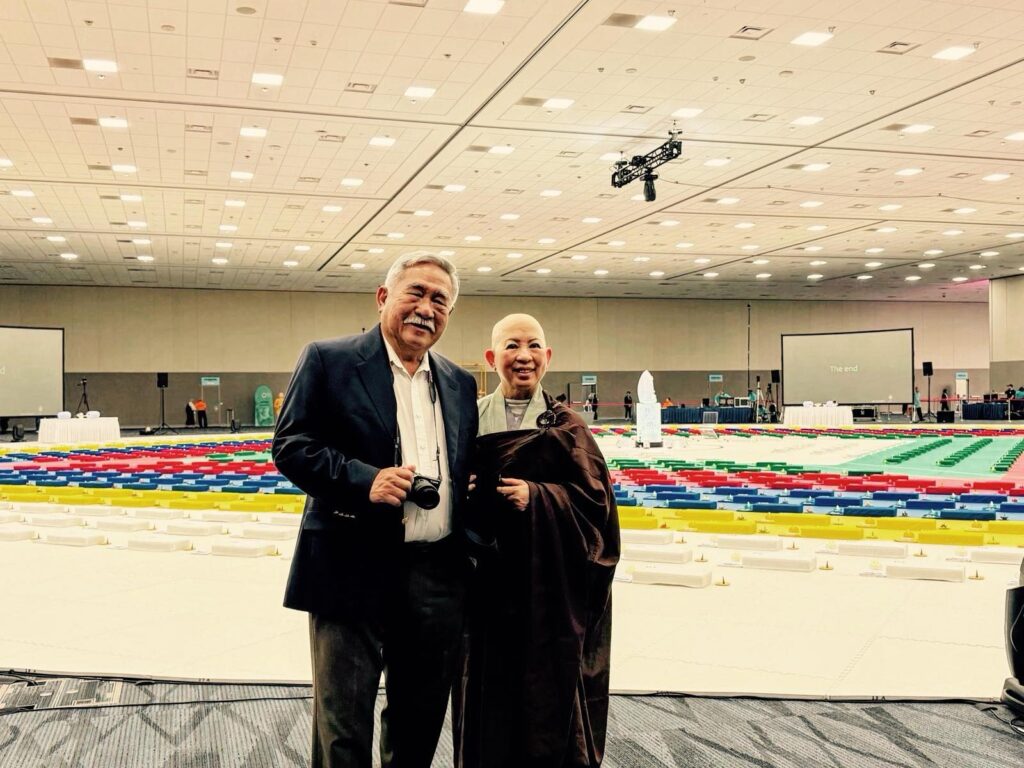
To prepare for the journey of spiritual study and practice as a Bồ Tát Hộ Pháp (Dharma Protector), I went to a local high school one weekend to listen to Thầy Hằng Trường speak about the World Peace Gathering that would be held in December that year. The friend sitting beside me was also a member of the Compassion Service Society in our area. She told me that participating in the Altruistic Home Leaving and attending the World Peace Gathering this year would be a very precious karmic opportunity because the program would include the presence of Venerable Nguyên Ứng from Korea, together with an exhibition of the Avataṃsaka Sūtra, which he had personally copied by hand.
At that time, I knew absolutely nothing about Venerable Nguyên Ứng. I only heard people in the Society say that he was a highly accomplished monk with very profound practice and that, many years earlier, he had used his own blood to copy the Avataṃsaka Sūtra.
What my friend shared made me reconsider my decision. I asked myself, “How many people in their lifetime have the karmic fortune to participate in an ordination retreat in the presence of such a great practitioner?” And then, almost without any further thought, I told my friend, “This year I will participate in Xuất Gia Vị Tha program instead of joining the Bồ Tát Hộ Pháp program.”
She looked at me with great surprise and asked, “Do you think your husband will agree?” Her question suddenly made me uneasy. That was right. I had made the decision to ordain so suddenly and without hesitation, but I had forgotten one important thing: Would my husband agree? Because my husband is Catholic, the fact that I suddenly wanted to participate in Xuất Gia Vị Tha, even though it was only a short-term program, would certainly not be easy for him.
When Faith Overcomes Doubt
At that moment, I realized that my sudden decision might not be as simple as I had thought. I had overcome my own hesitation, but another obstacle stood before me: how could I tell my husband and receive his wholehearted support for my decision?
Perhaps my friend could sense the feelings and concerns in my heart, so she suggested that I go with her to see Thầy and ask for his advice. Before that, I had never met Thầy. I only knew of him through his Dharma talks and retreats at the IB Center. After my friend introduced me, I told Thầy that I wanted to change from the Bồ Tát Hộ Pháp program to Xuất Gia Vị Tha and also told him about the greatest obstacle I was facing. After listening to me, Thầy looked at me and said very naturally, “Yes, you can do it. This time you will be able to go to Xuất Gia because your husband will agree. Not only that, he will support you in going in the following years, and he will follow me as well.”
Hearing this, I was extremely happy. Yet alongside my happiness, I still had some doubts. My husband was a devout Catholic, so I was not even certain that he would accept my going to ordain. As for the thought that he would follow Thầy, at that time it was almost unimaginable to me. I went home feeling both happy and nervous.
When I got home, I gathered all my courage and told my husband that I wanted to participate in Xuất Gia Vị Tha. Before this, he already knew that I would participate in the Bồ Tát Hộ Pháp program and would be away from the family for about ten days. In his mind, “leaving home” was probably simply another form of spiritual practice, similar to the retreats and spiritual programs I had attended before.
It was not until I explained that “leaving home” meant having my head shaved and living as a Buddhist nun, even if only for ten days, that he was truly shocked. Strangely, after his initial shock, he gradually became calm again. Then he agreed to let me attend the Xuất Gia program.
I do not know what caused him to change so quickly, and I did not try to find an explanation through logic or reasoning. My husband’s agreement strengthened my faith even more. I began to understand that there are times when faith in the Buddha Dharma goes beyond what reason can analyze and contemplate.
My Husband’s Hands and the Last Strand of Hair
A few days later, I went to a hair salon to have my head shaved. When I returned home, my husband noticed that there were still a few places where the hair had not been completely shaved. He took out the clippers and personally shaved my head again. His action deeply moved me. Only a few days earlier, he had been shocked when he heard me speak of “leaving home,” and now he was helping me complete the shaving of my head as I prepared to enter a new life.
That moment suddenly reminded me of what Thầy had said that afternoon. At the time, I thought his words were simply meant to reassure me and ease my worries. But now, as I watched my husband personally shave away the remaining strands of hair, I felt that Thầy’s words had become something deeper—a profound affirmation of my spiritual path.
In the years that followed, I returned to the Xuất Gia Vị Tha program every year. What moved me even more was that every year my husband encouraged me and willingly helped me shave my head. I do not know whether this was a miraculous arrangement of karmic affinities. I only know that I received my husband’s support, something I had never dared imagine on that first day. Each time, I felt deeply grateful to my husband. In a way that perhaps even he himself has never fully understood, he became part of the wholesome karmic conditions supporting me on my Xuất Gia Vị Tha journey.
A Little Bird and a Great Awakening
Several years before participating in Xuất Gia Vị Tha, I had already begun walking the path of spiritual practice according to the Thầy’s teachings. I continued to practice, attend gatherings, and participate in activities, but honestly, at that time my practice was still not very deep. I had not yet experienced a true transformation within myself.
Gradually, I came to understand that if something does not shake us deeply enough to awaken us, it is very difficult for us to truly change. My awakening did not come from a great loss. It was not caused by the death of a loved one, nor by an impasse or serious crisis in my life.
My awakening came from the death of a tiny bird. That day, I was participating in a practice session with a group of sisters from the Compassion Service Society at Tạo Hiền Sơn Trang. For some unknown reason, a little bird flew into the meditation hall. It fell to the ground and died in front of the Buddha altar.
It was only a little bird, yet somehow the sight had a very powerful effect on me. I asked myself, “Even a tiny bird like this, when it is about to die, finds its way to a place where the Buddha Dharma is present. What about me?”
Looking back, I realized that I had received so many fortunate conditions. I knew the Buddha Dharma, had a Dharma Master who transmitted the teachings and guided my practice, had wonderful Dharma teachings to practice, and had an environment in which to learn and practice. So why was I still not truly diligent? Why had I still not regarded spiritual practice as something of great importance in my life? Then another thought arose with great clarity: “One day, I too will be like this little bird.”
That thought left me speechless. For the first time, death was no longer something distant from me. It appeared very close, very simple, and very ordinary—like a little bird flying through the air, suddenly falling, and no longer able to take flight. I do not know why the death of that little bird made me think so deeply. It not only awakened compassion in me for a tiny living being, but also caused me to look deeply at myself.
From then on, I began to change the way I viewed spiritual practice. For me, that day became a turning point. I began to take my spiritual path more seriously, and eventually it led me to Xuất Gia Vị Tha.
From One Who Ordains to One Who Serves as a Dharma Protector
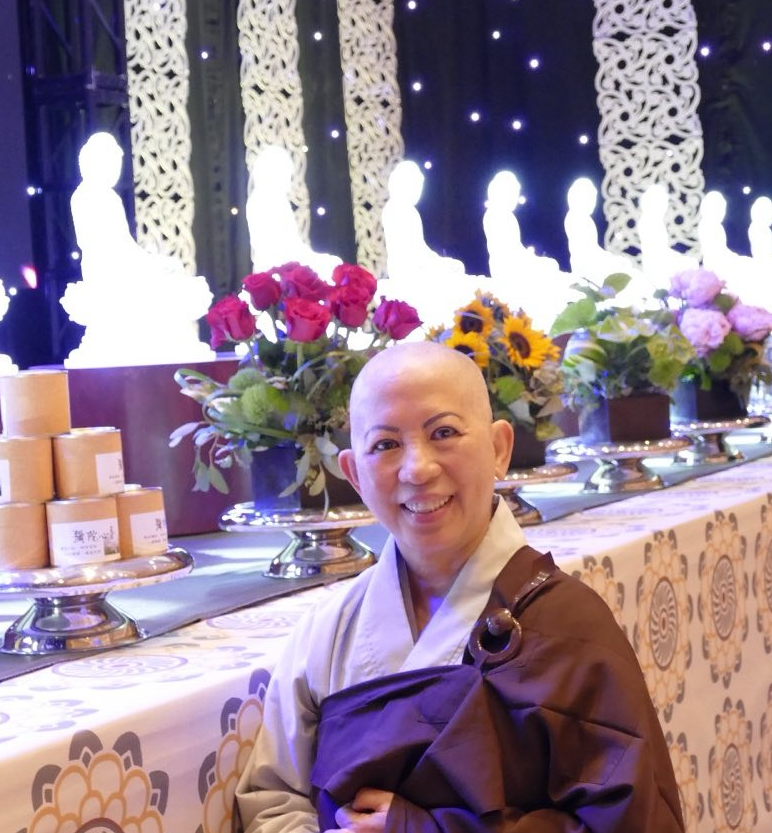
From my first Xuất Gia Vị Tha in 2014 until this year, I have registered to participate in Xuất Gia every year, except for one year when I chose to serve as a Bồ Tát Hộ Pháp. I wanted, at least once, to personally take on the work of a Dharma Protector so that I could more deeply understand what I had received during each retreat. Through the years of participating in Xuất Gia, I had been served and cared for wholeheartedly by the Bồ Tát Hộ Pháp, from the smallest tasks to the difficult and strenuous work that those receiving the service may not always fully see.
Many times, I shed tears when witnessing the sacrifices of the Bồ Tát Hộ Pháp—giving their time and energy, working quietly without complaining about hardship, and still doing everything with joy. Only when I myself took on the responsibilities of a Dharma Protector did I deeply realize how many selfless hearts were serving behind the peace and smooth functioning of every retreat.
Ten Days of Ordination and the Beginning of the Spiritual Path
Participating in Xuất Gia Vị Tha each year is not only an opportunity for me to return to the life of a practitioner, but also an opportunity to practice more deeply, to become more diligent, and to resolve that my practice will not be limited by circumstances or confined to any particular time or place. Therefore, the Dharma teachings we learn and the methods we practice throughout the Xuất Gia Vị Tha retreat do not end when the retreat is completed.
On the contrary, that is when we bring what we have learned back into our daily lives and continue practicing. This is also one of the things I find especially meaningful about the Xuất Gia Vị Tha program. After the retreat, we continue to have small groups where we practice together every day, with Coaches accompanying and guiding us, as well as practice sessions and monthly reviews. All of this helps our practice continue, so that we do not easily return to our old habits, and so that our spiritual practice does not regress or become stagnant amid the busyness of life.
I gradually came to understand that the ten days of Xuất Gia are simply a special period in which we step away from our ordinary attachments, turn inward, and devote ourselves wholeheartedly to spiritual study and practice. What is important is that after returning to our ordinary lives as lay practitioners, I remind myself to continue practicing and applying what Thầy has transmitted: The Bodhisattva path and the path of developing Bodhicitta. What is especially distinctive about Thầy’s teachings is that the spiritual path does not set a final destination and then stop once that destination is reached.
The Extraordinary Within Thầy’s Very Ordinary Life
I have profound admiration and respect for Thầy Hằng Trường. From the outside, I see Thầy‘s living, working, practicing, and teaching beings in ways that may not seem very different from other monastics. Yet hidden within that ordinary life is something extraordinary—a powerful presence that those who come close to him seem to feel immediately.
Thầy’s energy of giving is very strong. Those who encounter him can clearly sense something very deep within him. I often think that, in the form of a very ordinary person, Thầy carries the heart of a Bodhisattva. From that heart radiates a field of compassion, openness, and a kind of wisdom that rises beyond ordinary limitations.
When a Life Partner Becomes a Dharma Protector
He often says to me, “Thầy is a man of great character. He has gut.” The word “gut” that he used here is not easy to fully translate into Vietnamese. It expresses an instinctive feeling that a person possesses inner strength, integrity, a high level of “Essence, Energy, and Spirit” (Tinh, Khí, Thần), and something deeply genuine within.
What moves me is that my husband did not approach Thầy through the religious faith of a disciple. He simply observed, interacted with, and experienced Thầy as one human being encountering another. And through these very ordinary encounters, a natural respect developed. For me, this is one of the things that makes me admire Thầy even more: the extraordinary expressed through a very ordinary life.
As disciples, we all have reverence and gratitude toward our Thầy. I am no different. But one thing that particularly surprised me was my husband’s feeling toward Thầy. I had never imagined that he would develop such special respect for any Buddhist monastic because of the prejudices he had carried for many years. Yet I was truly surprised to see that after only a few encounters with Thầy, together with the stories I shared about him, my husband naturally developed a deep respect for him.
I have often wondered why my husband has such special affection and respect for Thầy while he still does not feel the same way toward other Buddhist monastics. But I know one thing: he has changed greatly. He not only accepts my practice with Thầy, but also frequently encourages me to be more dedicated to my spiritual path. Whenever I share with him the difficulties or obstacles I encounter in transforming myself, he always listens and encourages me.
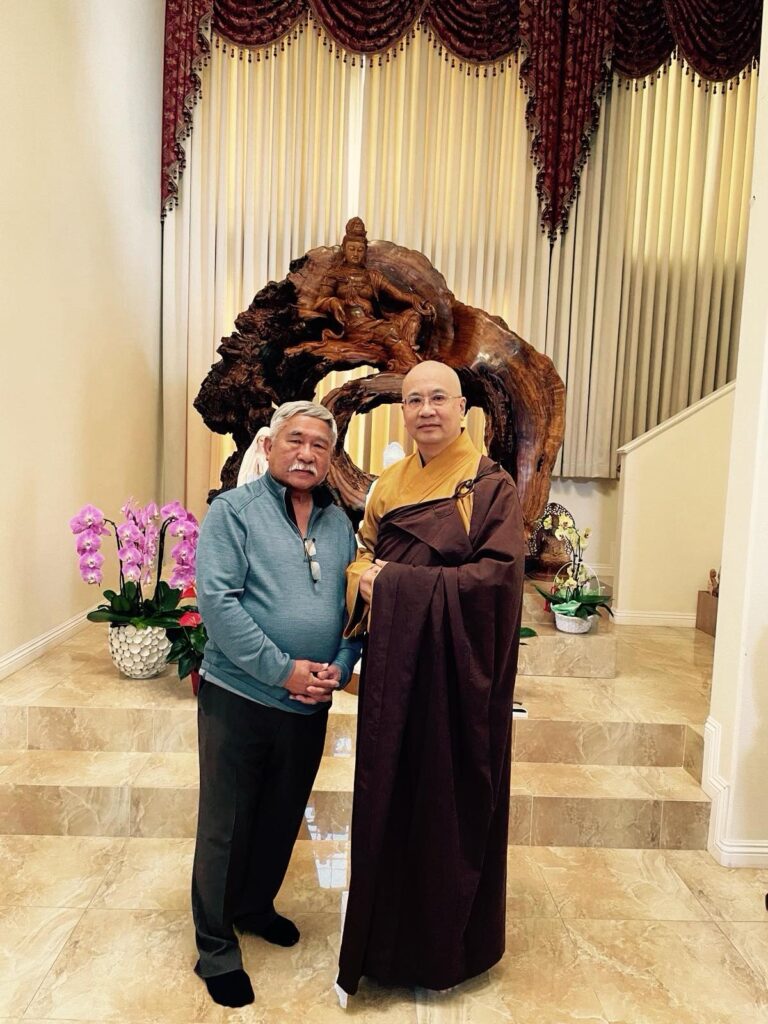
His support sometimes does not come through grand words, but through very ordinary things. He often reminds me, when I go to teach my wellness exercise classes, to be on time and to arrive a little early so that I have time to greet the students and build connections with them.
Looking Back on the Journey
Looking back on the journey from the day I first decided to participate in Xuất Gia Vị Tha until today, I feel more deeply than ever that no karmic affinity is truly accidental. A little bird unexpectedly fell in front of the Buddha altar. A friend’s words. Thầy ‘s affirmation. The agreement of a husband whose support I had never dared imagine.
I am even more deeply moved when I remember my husband quietly holding the electric clippers and shaving away the last strands of my hair. In his eyes and in his understanding, I sensed something deeper. To him, whether I had beautiful hair or no hair was not important. What mattered was the aspiration and spiritual joy of his life partner as she prepared to embark on a journey of spiritual practice and live the life of one who has temporarily left home for the sake of others. Things that seemed so small at the time, when I look back now, have become links connecting one part of my spiritual journey to another.
I deeply cherish and give thanks for all the fortunate conditions and blessings I have received in this life. I offer my gratitude to Thầy. Thank you to all the Dharma Protectors, my fellow practitioners, my family, and all those who have quietly helped make the aspirations of people like us who participate in Xuất Gia Vị Tha come to fruition.