By Mai Tran Nguyen (Dharma Name: Thân Mỹ Ngạn)
Question: Could you please tell us a little about yourself?
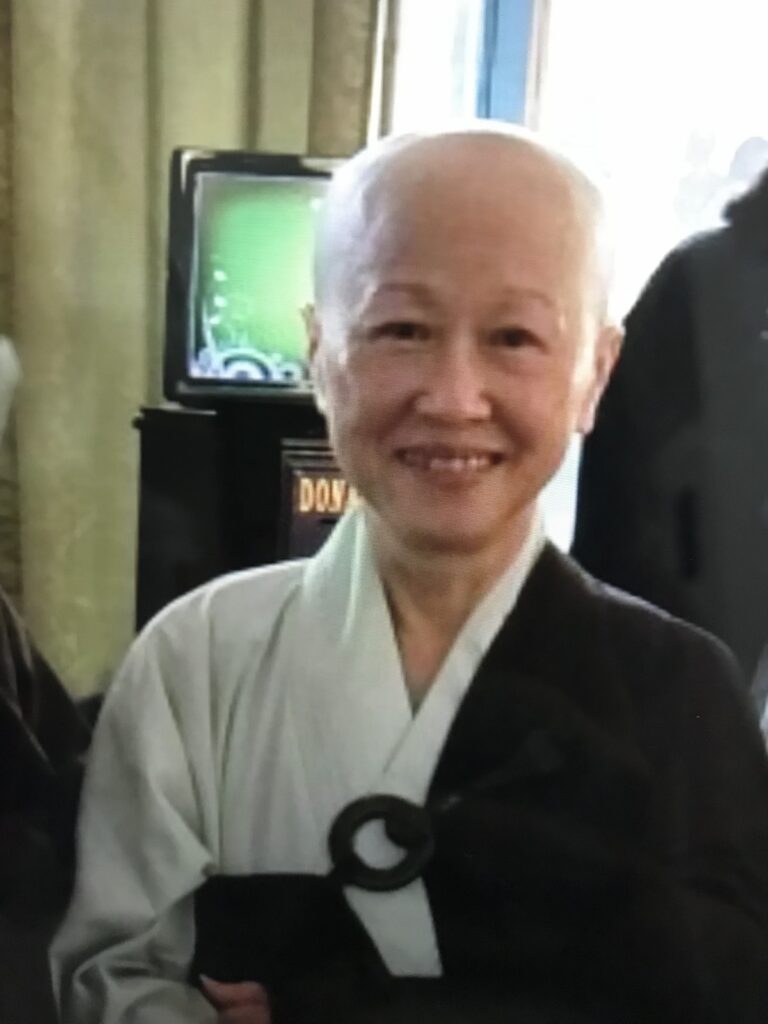
Mai Trân: My name is Nguyễn Mai Trân. I’m 75 years old and live in North Carolina. Since childhood, I have been closely connected with Buddhism and often went to the temple. The abbot was very kind and guided me in chanting sutras. From then on, the sound of the bell and the wooden fish became familiar, and my faith in the Three Jewels deepened. That faith has nourished my spiritual life throughout the years.
Question: How did you come to study the Dharma with Thầy Hằng Trường?
Mai Trân: It was a very special karmic connection. I had never even heard of the Thầy before. One day, a friend invited me to a meditation class with Thầy Thông Triệt. After the session, someone asked, “Are you studying with Venerable Hang Truong?” I was puzzled—I didn’t know who that was.
A few days later, a friend sent my husband a poem titled “Can Khon Thap Linh Exercises” that mentioned Thầy Hằng Trường. I read it and was immediately drawn in, so I went online to listen to his teachings.
From the very first talk, I was captivated—especially by how the Thầy intertwined Journey to the West with Buddhist history, explaining each part with wisdom and compassion. His extraordinary memory, engaging storytelling, and profound insight helped me understand the path of practice more deeply.
From that day on, my husband and I listened to his Khai Tam program every night for hours. Those teachings became a guiding light, opening in me a new awareness of the Dharma. Before, I thought spiritual practice meant simply living kindly, keeping faith, and avoiding bad karma. But now I understand that true cultivation is the evolution of consciousness—nurturing the beauty within oneself and recognizing the beauty in others.
Later, I watched a video of the Venerable teaching the Great Compassion Mantra in San Jose. He said, “Whoever wishes to study with me should vow to recite the Great Compassion Mantra 100,000 times.” I made that vow and chanted every day—sometimes while doing housework.
My husband lovingly told me, “Just keep chanting. I’ll take care of the house and the cooking.” In 2015 after 18 months, I completed all 100,000 recitations.
Then, my husband and I began practicing “Can Khon Thap Linh” together for several years, and our health improved significantly. When I heard about the Temporary Home Leaving (XGVT) program, I was determined to participate. I told my husband, “I’m going to be a nun!” He laughed, “You’ll have to shave your head—that’s strange!” I replied, “What’s strange about that?”
Question: So you actually shaved your head and ordained?
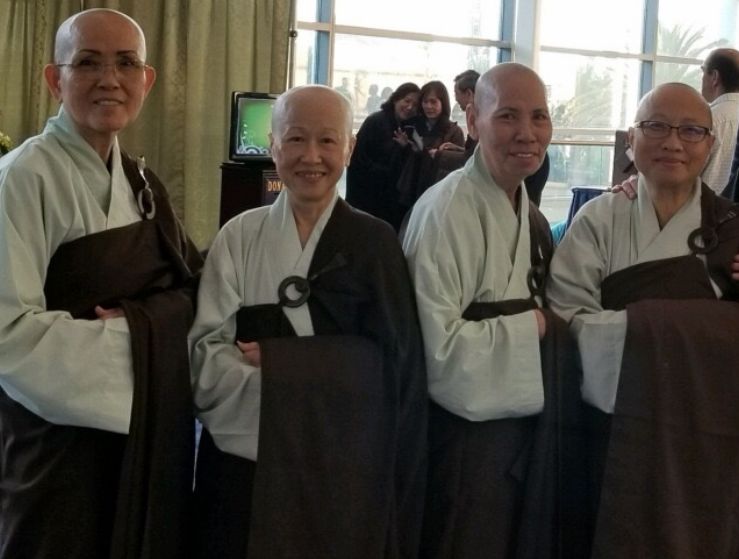
Mai Trân: Yes, I did—in 2014. It was my first time joining the ordination program. I didn’t know anyone there, but I wasn’t nervous at all. The day I shaved my head was also the first time I met the Thầy in person. I said, “I have studied meditation with Thầy Thông Triệt and took refuge with Thầy Thích Tâm Châu for many years, but today I’m deeply happy to be ordained by you.”
He looked at me quietly, his eyes full of compassion and understanding. In that moment, I felt a gentle peace spread through me, and tears began to fall. He shaved my head and gave me the Dharma name Thân Mỹ Ngạn, meaning “Beautiful Shore.” He said, “Cultivate diligently so you can help your parents cross to the other shore.”
At that time, I didn’t fully understand his words. It wasn’t until ten years later, when I read the Heart Sutra and came across the verse “Gate gate pāragate pārasaṃgate bodhi svāhā”—“Gone, gone, gone beyond, gone completely beyond, enlightenment, hail!”—that I finally understood. Thầy had seen my heart’s aspiration long before I did.
Question: Do you have a particularly moving memory from your practice?
Mai Trân: Yes. Each time I hear Thầy chant the line “Om Si Dan Do Man Do La Ba To Ye So Po Ho” . I can’t help but cry. I don’t know why—my heart just melts into the sacred vibration of the mantra. Perhaps, in the most divine moments, tears are the purest language of the heart.
Question: How many times have you ordained?
Mai Trân: Three times. The first was in 2014, but afterward I stayed home to care for my grandchildren. The second was in 2018, and again I had family duties. Finally, in 2024, I was able to return.
Once, Thầy said, “If you cannot attend a retreat, make a vow to perform 100 bows each day.” So I followed his guidance and did 100 bows a day for 1 month, 30 days is 3000 bows, dedicating the merit to my loved ones. Even when I couldn’t attend in person, I maintained my devotion through each bow and each breath.

Question : It seems your family is very supportive of your spiritual path.
Mai Trân: Yes, that is a great blessing. My husband has a sincere spiritual heart. He deeply respects the Thầy’s teachings and especially enjoys studying the Avatamsaka Sutra (Flower Ornament Sutra). He has memorized several chapters—The Chapter of the Virtuous Leader, The Ten Abodes, The Ten Practices, and even the Surangama Mantra. But he always says, “I’ll just practice at home—I don’t have the good deeds to be a monk.”
I remember back in 2020 when the COVID pandemic was spreading across the world, the Master called on everyone to bow to the Buddha in prayer. He urged people to perform 100 bows each day for a whole month, dedicating the merit to those who were ill, living in fear, or had just passed away due to the pandemic. My husband immediately made a vow to follow the Master’s guidance and completed 3,000 bows that month. As for me, I was inspired to perform 10,000 bows over the course of two months
Our children were born and raised in the U.S. So at first, they didn’t understand much about spirituality. They worried because I seemed to change so much—my diet, my daily habits, even my circle of friends. One of them asked, “Mom, are you in a cult?” I gently explained and showed them photos of my ordination. Since then, they’ve understood and respected my practice.
Now my daughter even says, “Mom, please pray to Guan Yin for me.” When I hear that, I know that faith has begun to take root in her heart.
Question: What would you like to say to those who wish to ordain but still hesitate?
Mai Trân: Ordination is a matter of karmic affinity. But from my own experience, I can only say this: if you have the opportunity, don’t hesitate—join the Temporary Home Leaving program. It will change your life forever.
Many people wonder why someone would give up everything to ordain. They think it’s too big a decision, too difficult a step. But truly, it’s not hard at all. Fears about shaving your head, leaving family, or living among strangers—those are just attachments, shadows of the mind. Once you let them go, your heart becomes as light as a cloud, and the path of practice opens before you—radiant, peaceful, and full of light.