Mai Beck / Thân Mai
I have joined the Altruistic Home Leaving Sangha three times, the first in 2008 when a close friend fell gravely ill. At that time, I had just encountered the teachings of Thầy Hằng Trường and realized this was the Dharma I had long been searching for. Although I already had deep faith in Buddhism, I still did not know how to apply the Buddha’s teachings to daily life.
Beginning with Thầy’s lectures on the philosophy of the Five T’s and Five R’s, or 5 Domain of Practices and 4 Levels of Consciousness, it was a completely new door opened for me in understanding and practicing the Dharma. The philosophy of “Transcending Worldliness-Engaging with the World” came like a fresh breeze—pure, new, and awakening. It became a guiding compass, showing me a concrete, practical path of practice that could be walked immediately in everyday life.
One day, I heard Thầy speak about the Altruistic Temporary Home Leaving program—a noble vow where one ordains and practices on behalf of those who are sick and suffering. Without hesitation, I vowed to ordain in place of my friend who was facing danger, hoping this would create merit and conditions to help him overcome his crisis.
At that time, the sangha had only a few members. We practiced on a mountain in China. I no longer remember the mountain’s name, but the strict discipline of practice, together with the quiet forest scenery, brought me back to the image of ancient monks—simple, pure, and detached from the noisy world.
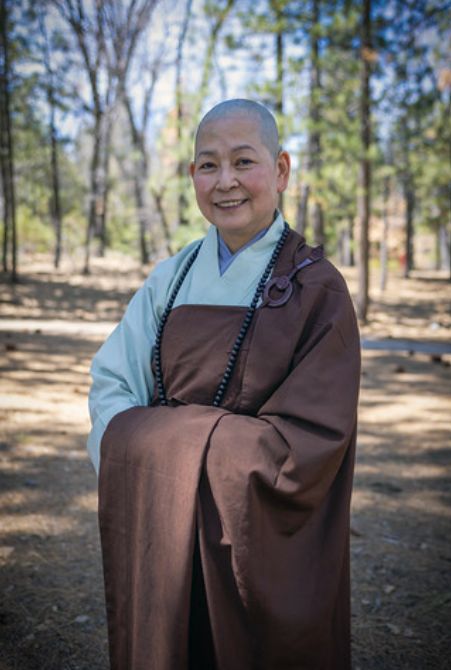
The Moment of Shaving the Head
The first time Thầy shaved my head was a sacred experience I still remember as if it were yesterday. Though I had prepared mentally, when the locks of hair truly fell, my heart rose with a tender, indescribable lightness. I knew it was the joy of letting go, not confusion or regret.
I realized I had overcome attachment to form faster than I imagined. And recalling the noble meaning of altruism, my heart was filled with love and excitement directed toward my sick friend.
A miracle happened: that friend later recovered completely. For me, this was not mysticism, but the result of faith, merit, and the pure energy of an altruistic heart.
Deep Faith in the Buddha Dharma
This experience strengthened my deep faith in Buddhism, in the Bodhisattva path taught in the Avatamsaka Sutra, and in the practice of serving others that Thầy continually emphasized.
When the mind is directed toward the benefit of sentient beings, wholesome energy can transform suffering and bring peace in ways human reasoning cannot explain.
Looking back on my first ordination and the ones after, I realize my spiritual path has changed greatly. These changes were cultivated in the spirit of altruism during the retreat, together with the Dharma I have studied for more than ten years.
At the core of everything is the motivation for practice. Why do I become a temporary Buddhist nun? Why do I revere Thầy’s teachings? Before, I had no clear answer. But now everything is clear: it is compassion and altruism.
It is compassion that moved me to ordain. It is altruism that helped me absorb the Dharma deeply and understand the path Thầy guided. Thanks to these elements, practice became alive, meaningful, and full of transformative energy.
From a Contracted “Self” to an Open Heart
Losing my parents at a young age, I grew up in loneliness and constant fear of the future. At times, the sorrow was so great it robbed life of joy and meaning. As I matured and walked the spiritual path, I realized many people were more unfortunate than I, yet they still lived positively. That urged me to strive harder in learning the Dharma.
Through practice, I gradually realized: when the mind circles around a heavy “self,” life becomes cramped and gloomy. When the mind turns outward, thinking of those who need us, the heart naturally opens.
This is the spirit of “Transcending Worldliness- Engaging the World”, we must experience the inner peace of one’s own mind, while also engaging in life with a larger heart.
That Dharma changed me. I no longer only clung to my own suffering. I learned to live for others, even though I am not a skillful practitioner or deeply knowledgeable like many fellow practitioners.
Whoever needs prayer, I pray. After each session, I dedicate the merit. And strangely, I immediately feel joy from this act of “giving.”
In the past, I only wished to be loved and understood, but the more I wished, the more disappointed I became. Now, I only wish to give—a prayer, a concern, a peaceful energy—and joy naturally arises.
From this I understood that altruistic ordination is not something distant. It is simply sacrificing a part of oneself to bring peace to others.

An Unforgettable Sangha Retreat Memory
During my first ordination, I was slow, clumsy, and hardly knew anyone in the sangha. Yet in that situation, a profound memory imprinted itself in my heart for more than ten years.
That day it rained. I had no umbrella, no raincoat, so I just stood there getting wet. Suddenly, from afar, a sister in the sangha—later I learned her name was Hạnh Lê—hurried toward me, holding an umbrella. She gently took my hand and sheltered us both.
Just a small action, but for me, it was a great gift. Her gentle eyes, warm smile, and sincere care made me feel a tender yet profound love, like that of a sister.
That is the spirit of altruistic ordination—opening hearts, supporting, and loving one another in a shared soul. That memory nourished me for many years, becoming a source of inspiration on the path of practice and service.
Ten Days of Practice Filling the “Spiritual Vessel”
Though the retreat lasted only ten short days, every lecture and method Thầy taught was a lifelong lesson—brought home and applied daily, immensely beneficial.
I always remember Thầy’s words: Practicing the Bodhisattva path means never ceasing to evolve, never ceasing to open the heart, never ceasing to serve, never ceasing to benefit others.
I often liken the ten days of altruistic ordination to a pump filling my “spiritual vessel.” No matter how empty the vessel was, those ten days filled it again.
And it is precisely those cherished memories—like Dharma Sister Hạnh Lê’s umbrella—that made me understand that in the most ordinary moments, we can recognize the extraordinary.
That enlightenment does not only come from distant saints, but can also manifest in ordinary, close people around us.