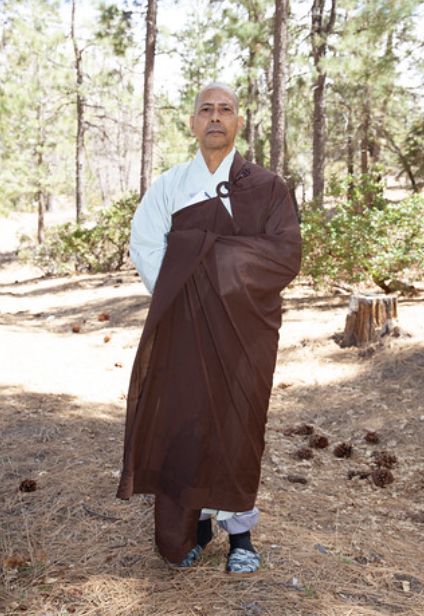
By Ralph Maamaatua – Dharma name: Thân Khai Thuận Hí.
From Tahiti to Los Angeles, there are no less than 6,000 kilometers. I covered that distance in 8 hours by plane, something my ancestors would have done in a month and a half by double canoe. Since my arrival at Tom Bradley International Airport, challenges had arisen—but I overcame them one by one. I only had one goal.
Christian by Family Tradition.
I retired from my role as a communications officer in 2018 and have four wonderful children—three daughters and one son. Like me, all are baptized Catholics.
A Long-Ignored Spiritual Calling
Buddhism has always held a certain fascination for me. Even as a young adult, I felt its subtle calling—but I ignored it for a long time.In Tahiti, where I live, Christian religions are predominant. Catholics, Protestants, Mormons, Adventists, Pentecostals, Evangelicals, Jehovah’s Witnesses, and other newer churches coexist without visible conflict.
The Asian community—mainly Chinese—is a minority. Traditionally Taoist, the only Chinese temple in existence is the daily site for traditional offerings to the god Kanti and the oracles. Among the deities honored in this small temple, Kuan Yin holds a special place. Though placed to the side—near the entrance—her statue is the largest. The garden hosts the community’s annual cultural day and the celebration of the Chinese New Year.
The island has only one Buddhist meditation center, which opened in 1993 and follows the Tibetan tradition with about forty practitioners.In 2018, shortly after beginning my Integral Tai Chi practice, I was introduced to meditation by Mr. Thanh, founder of CSS Moorea Tahiti. Step by step, I came to know the Buddhist culture of my mentor and the Avatamsaka Sutra school under the guidance of our teacher, Thầy Hằng Trường. Defined by compassion and love, Thầy’s teachings and his warm personality convinced me of the kindness of this tradition. Since then, I’ve continued deepening my knowledge and nurturing my Buddhist practice. That said, I have not abandoned my Catholic practice.
In 2022, Polynesian friends invited me to explore their Tibetan Buddhist practice. When I was offered the opportunity to take the Three Refuges via Zoom with a Tibetan lama I didn’t know at all, I quickly declined.
Cancer—The Shadow That Devours My Family
For years, cancer has been gnawing away at my life, piece by piece. It took my father, who died of throat cancer. It claimed my mother, ravaged by breast cancer that spread to her lungs. My oldest sister is fighting the same disease. My younger sister battled thyroid cancer. And now, the eldest and youngest of my children are affected by a rare and incurable cancer. They are still young, but their future is so uncertain—perhaps even improbable—it breaks my heart.
Each diagnosis is an electric shock, a crushing blow. Each treatment, a trial. Every day is a battle against the fear of losing another loved one.
I live with the constant pain of seeing those I love suffer, both physically and emotionally. Fear never leaves me. Powerlessness consumes me. It’s not just a challenge—it’s a recurring tragedy, an endless fight.
And yet, I must stand strong—for them—so as not to fall apart. But I must say it: I’m hurting, deeply. Still, I must go on being strong—out of love, duty, and hope, however fragile—and I try to persevere in the shadows.
A Fervent Desire for Compassion
A year and a half ago, a genetic test in Paris revealed the origin of my eldest daughter’s paraganglioma. Following that, my three other children, my two sisters, and I were all tested. The analyses were sent to France and took a long time to process, with results arriving very slowly.
After my son’s positive genetic test last August, further tests and analyses followed. By the end of September, a final diagnosis was made, and his medical evacuation to Paris was scheduled for the end of the year. From that moment, an indescribable anguish gripped my throat—like a scream choked by pain, guilt, and confusion. My Buddhist practice intensified, and I prayed every morning for Kuan Yin’s help.
On the internet and social media, I came across announcements from the Compassionate Service Society (CSS) for the Mandala 2025 and the Altruistic Leave Home program. I decided to participate in the retreat and the Mandala to pray for my two children.
No Matter What Happens
Six months before leaving for the U.S., I had adopted a vegetarian diet to manage stage 3 kidney failure. As a result, I lost 10 kilograms, which led to low blood sugar, faintness, and blackouts. Several consultations with my cardiologist, nephrologist, and vascular specialist were needed to stabilize my medical condition. Yet my determination remained unwavering.
Taking Refuge in the Three Jewels
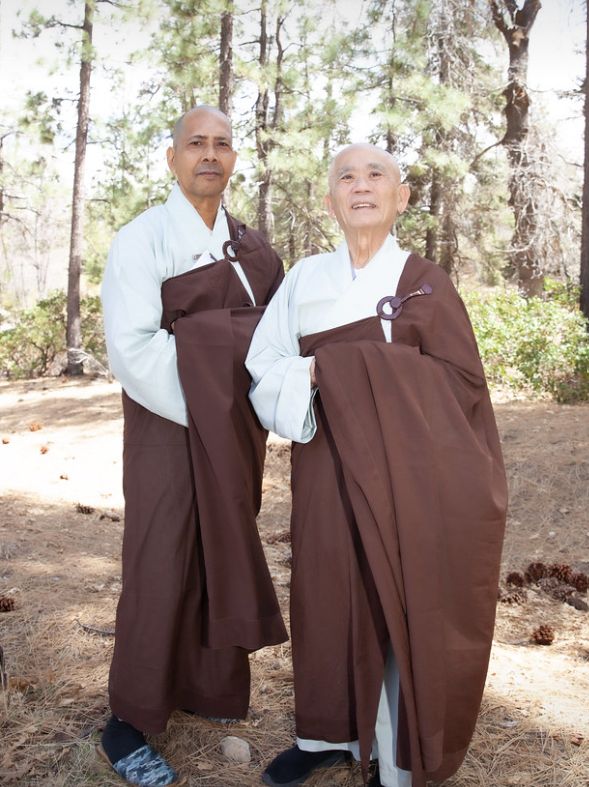
Taking refuge marked a key milestone on my spiritual path.Before receiving the precepts, the shaving of our heads as temporary monks and nuns was our first step toward renouncing worldly life. It was a very powerful moment—perhaps even more so for novices like me. I couldn’t hold back my tears when I spoke of my two sick children, to whom I dedicated the merit of my cultivation.
Receiving the precepts to become a temporary monk or nun, vowing renunciation, is a truly deep commitment to sincerely cultivate the qualities of the historical Buddha—the Awakened One. That is our first refuge.
Understanding the essence of the Dharma and applying it in daily life is essential. It’s the foundation of our spiritual development, the bedrock of our Buddhist faith. Joining the Sangha is vital for drawing inspiration from others who strive to cultivate the same qualities of kindness and compassion.
Taking refuge in the Three Jewels gave my spiritual practice an entirely new dimension. The commitments we made must be renewed every day—even after we return our precepts. My Dharma name within the Sangha is Thân Khai Thuận Hí.

A Form of Priesthood for the Healing of My Two Children
I understood clearly that during this retreat, I wasn’t meant to become a monk for life. Taking the Three Refuges, living the precepts of a novice for two weeks, immersing myself fully, and offering the merit of my sacrifices to my two children—this was a true spiritual endeavor.
At Pine Summit Camp, I discovered a different way of life, a different climate, a different culture, a different language. But we are all human beings, alike in our virtues and imperfections.
It was my first retreat with CSS. I joined the Sangha I had been following on Zoom. Some familiar faces welcomed me warmly and made me feel at ease.
I made many new friends—Dharma friends, Dharma brothers and sisters. I integrated easily; the connection felt natural. I was filled with joy.
Underestimating Big Bear’s climate, I wasn’t prepared for the cold nights. Unused to the cold and not dressed warmly enough, I caught a chill on the very first night. It weakened my body, but I had to endure it at all costs—for my children.
In Total Seclusion
Pine Summit Camp is a new environment for me—the nature, the forest, and the snowy peaks are extraordinary. The place is beautiful, the members of the Sangha are kind, and I felt at peace.
On the first day, I settled into dormitory 6A with the young “pro students,” as Thầy calls them. It was my first time meeting them, but I had the strange feeling that I had already known them—a kind of déjà vu that was a bit unsettling, though not unpleasant.
This silent retreat brought me deep inner peace, favorable for reflection on my life’s mission, and conducive to prayer. It was an exceptional experience—one of complete seclusion. Days and nights where mindfulness was continuously activated, 24/7, in everything I did—from sunrise to sunset, and perhaps even during sleep.
So Many “Wows”
Meditation sessions, teachings, and physical exercises followed one after another. The schedule was packed, the days were long—but built-in rest periods gave us time to recover.
Receiving Thầy’s teachings in person, in the midst of the Sangha—meditating, chanting mantras, and praying together—had a whole different power. A synergy so strong that it easily carried us beyond the borders of consciousness. It was a true “Wow,” as Thầy would say.
I lost track of time. I never tired of practicing and listening to Thầy’s new teachings.The new meditation where we activate the column of light was extraordinary. Like the “six hands and eyes” meditation—my favorite—it transported me.
During the retreat, the story Thầy told us about the sacred lands of Hawai’i deeply touched me. Of course, it spoke to my heart—those distant cousins who populated the Hawaiian Islands in ancient times traveled in double canoes from my homeland. Hawaiians call Thầy “Kahuna”; in my land, we’d call him “Tahu’a.” A spiritual master who uses no earthly remedy, but who connects with the spirits of the dead and resonates with the divine. Being a “Tahu’a” isn’t a choice—it’s a destiny.
Naturally, the story of Thầy’s encounter with an Arhat at the summit of Mount Otemanu on Bora Bora was astounding and full of mystery.
When Thầy asked me if we used mantras in Tahiti and on our islands, I replied yes without thinking. Thinking back, I should have reflected my answer. There are indeed similarities between Polynesian and Asian, even Buddhist cultures—like all traditions tied to nature. The five elements, the duality of visible and invisible worlds, etc. My ancestors were polytheists, and spirits inhabited every part of nature, every object made by human hands. Our legends overflow with fantastic tales. There’s no doubt that in pre-European Polynesian culture, a divine language existed, known only to the priests—the “Tahu’a.” But our oral tradition left no written trace of this ancient knowledge. Only a few rare “Tahu’a” still communicate with the gods of our ancestors—during fire-walking ceremonies, for example, or before a traditional sailing canoe voyage between the islands of the Polynesian triangle: Hawai’i, Aotearoa (New Zealand), and Rapa Nui (Easter Island). Tahiti and her islands are the epicenter—the launching point—of my ancestors, my tupuna, who set out to colonize these new lands, likely revealed in the dreams of visionary priests.
Master Hằng Trường and my vow
Master Hằng Trường has many gifts. He’s a brilliant speaker, an eloquent ceremony master, a man full of human qualities, a humble and generous spiritual guide, and an undisputed Dharma master. One cannot help but love him and feel deep gratitude.
The teachings received during the retreat brought tremendous depth to my spiritual practice. I now cultivate the Path differently—perhaps with more conviction. I’m only at the beginning of my journey. I feel good where I am—this is the Path I want to continue following.
This retreat confirmed my choices as a Buddhist practitioner and truly inspired me to continue my initiation within the Hoa Nghiêm school.
I vow to return next year.