MY TEACHER (IN THE DHARMA PATH)
“The young man, born of noble lineage,
Set aside brush and ink, took up sword and bow…”
(From “Lament of the Soldier’s wife” – Đoàn thị Điểm, Nôm script version)
That is my master, but he did not “take up sword and bow.” Instead, he “folled the path of Huayan school.”
Thu Tân Khang Tại
(Penned in a moment of inspiration, July 2025)
The light gray section above was the opening of a six-page essay written on March 15, 2014. In a blink, eleven years have passed. Seven times I have ordained, countless times I have changed “roommates.” But one thing remains absolutely unchanged: one Master, a noble being, a true Spiritual Friend (善知識 – Thiện Tri Thức). Venerable Master Hằng Trường still holds the central seat in the Dharma hall, still wears the same black inner outfit; when needed, he dons the golden outer robe—vibrant like fresh turmeric—and the solemn brown sash. That is my Master! Truly a “noble being,” both literally and figuratively.
Literally, “noble being” refers to his physical stature—he stands as tall as a Westerner; when I stand beside him, my head barely reaches his shoulder. I remember in April 2025, after the “Altruistic Leaving Home Retreat” (XGVT), the CSS family (from all locations) gathered at headquarters. As disciples lined up to bid farewell to the Master, I had to quickly walk up two steps in the receiving-guest room so that he would not have to bend his knees to embrace me. Writing this reminds me of a quirky comparison: According to the legend of the Dragon and Fairy, after giving birth to a sac of 100 eggs, which hatched into 100 children, Lạc Long Quân and Âu Cơ parted ways—50 children followed their father to the sea, and 50 followed their mother to the mountains. Today, our Master has even more than 50 “children” (disciples); and they do not just dwell in the mountains—they reside peacefully everywhere.
Rather than leading us up the mountains, our Master guides his “flock” along the Bodhisattva path, as taught in the Avataṃsaka (Huayan) Sutra. So, when the retreat ends and it is time to part, Master Hằng Trường’s “children” line up—filling the guest room—to embrace their “young father” (for “Master” also means “Father”) in farewell. Then, the disciples turn to embrace one another before returning to their respective homes. From all corners of the world, whenever there is an XGVT retreat, the “children” return as if to their loving home. First, to revisit a place of peace, love, and warmth; second, to see their “young father” and receive training in body and mind, to listen to the Dharma—which grows more wondrous each year. The more disciples, the greater the joy; the more open the arms and hearts become.
And during group photos, I’ve sometimes hidden behind the towering figure of this “Noble Being”—partly to practice the principle of “formless and invisible” that I’ve long studied (for what’s learned must be practiced), and partly to enjoy the comfort of “sheltering in Compassion.” In the past, when I heard the phrase “sheltering in Compassion,” I vaguely imagined Buddhas and Bodhisattvas (embodiments of Compassion), and wondered: how can I take refuge in their shadow when I have never met them in person? But now, I understand—Bodhisattvas are not far away. Many “little Bodhisattvas” live quietly among us. And my Master has given me a spiritual shade to rest under, to rely on as I cultivate my mind and transform my character. Not just for me, he offers this to many beings—seen and unseen, sentient and insentient—and continues to give, tirelessly and selflessly.
Figuratively, “noble being” refers to a true Spiritual Wiseman—one of vast wisdom and eloquence, as countless as grains of sand casually scooped up in a hand. My Master’s knowledge is immense, both innate and cultivated—nurtured by his own Master, the Great Venerable Hsuan Hua, and deepened through tireless study of scriptures and dedicated daily practice, leading to profound realization. He faithfully follows the teachings of Master Hsuan Hua, developing a path of cultivation based on the Avataṃsaka Sutra and the Great Compassion Mantra, structured as follows: (a) One Huayan Bodhi Mind, (b) Two Dimensions of Cultivation and Practice, (c) Three Directions of Development, (d) Four Methods of Burden Resolution, (e) Five Ways of Simple Living, (f) Six Hands of Avalokiteśvara.
Like the Monkey King—undaunted by mountains or oceans, soaring through clouds and storms, unafraid of dragons or gods—who ultimately could not leap beyond the Buddha’s palm (those five towering fingers like the Five Elements Mountain). I too, despite my restless monkey mind, remain under my Master’s guidance. He knows my karmic roots, my spiritual capacity, and my cultivation as clearly as the lines on his palm. He simply does not say it aloud—but he knows it all (thoroughly/completely).
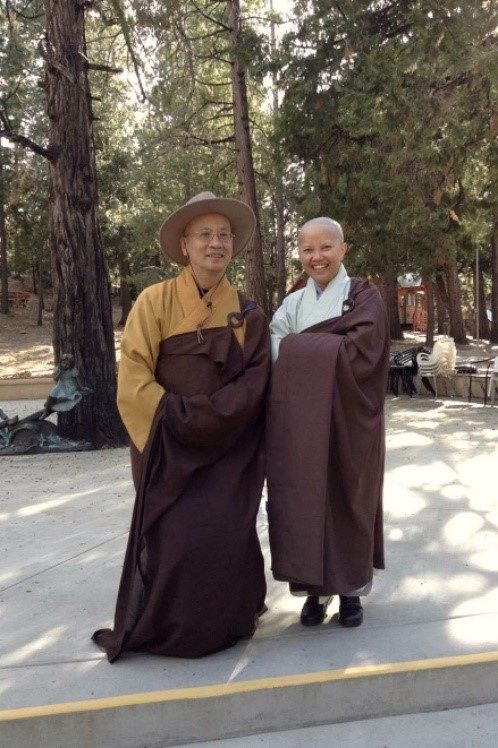
During my first ordination in 2017, I learned humility from my Master. According to the 1960 Sino-Vietnamese Dictionary by Nguyễn Văn Khôn, khiêm cung means “modest and respectful.” But here, I wish to express a deeper meaning: khiêm cung as a way of being—humble and unassuming. There is an American song titled “If” with the line: “If a picture paints a thousand words, then why can’t I paint you?” I want to share a photo taken with my Master during that first ordination-head newly shaved, wearing a robe and kashaya. To me, this image portrays the humbleness and unassuming traits (as I define it) of a wise Master toward an inchoate, undersized disciple. The photo speaks volumes—through posture, smile, expression, background, and lighting—but I will leave that reflection to each viewer. As for me, I will carry this image for the rest of my life, as a reminder of the “noble being” who, with both virtue and wisdom, accepted a humble student like me.
And finally, I have come to realize a timeless truth passed down through the ages: A great Master produces great disciples. That great disciple is my Dharma brother!
My Dharma Brother
His Dharma name is Khai Nghiêm who carries within him a rich heritage—Vietnamese and Chinese by blood, raised in France. In his early twenties, after achieving academic and professional success, he let go of his worldly career and ordinary life to walk the spiritual path. He committed himself to the Huayan tradition, dedicating his life to service and the practice of the Bodhisattva ideal.
He is a “distinguished disciple,” not only in stature—standing nearly as tall as our Master—but also in spirit. He ordained under our Master at a very young age, during his teenage years. In some ways, he even surpasses our Master: he is younger, fluent in more languages (French, English, Vietnamese, and Chinese), and has endured a more painful family history (as I learned this during his visit to Houston in March 2025, when he came to promote the XGVT program. Though I was busy with errands and only caught fragments of his sharing, his gentle and composed words still conveyed the deep sorrow of his family’s past.) He also has the rare privilege of being an older brother—at least to one person. He has a younger sister, who appeared at the recent XGVT retreat in April 2025, accompanied by their elder sister from France. Our Master, on the other hand, being the youngest son in his family, never had the chance to be an “older brother” in the biological sense.
Despite his youth, Khai Nghiêm always responds with thoughtfulness and care. During the XGVT retreats, his robes are always immaculate and dignified, radiating the noble presence of a model novice monk. In the past, I found him to be rather serious and reserved. But that changed after I sent him a brief email with just two words: “Mô Phật”, expressing my gratitude for being one of the last to be accepted into a time-sensitive program. Since then, whenever we meet, he greets me with a warm smile and the same phrase: “Mô Phật”. I return the greeting in kind.
In earlier years, he oversaw the entire XGVT program. Later, following our Master’s guidance, he passed some responsibilities for the U.S.-Europe branch to Dharma brother Vũ Thượng Quân. Khai Nghiêm now resides in Taiwan, where he focuses on developing and training the monastic community in Asia. He successfully led the first XGVT retreat there in 2024, with 50 novice monks and nuns, under the formal recognition of our Master.
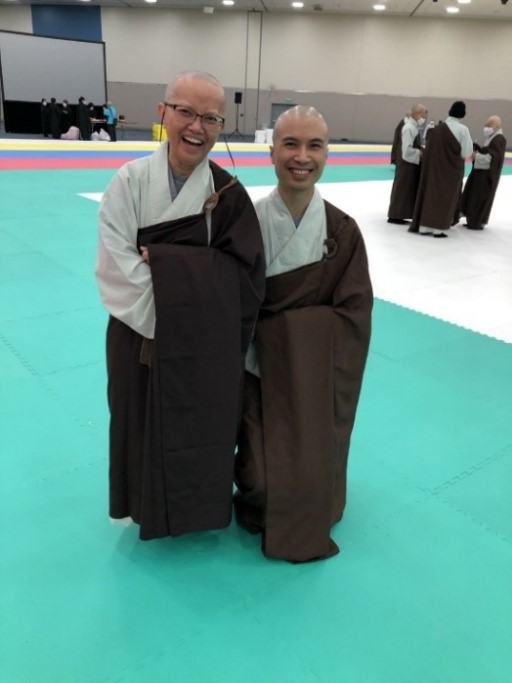
As time passed and opportunities to work together increased, I gradually grew closer to him. Our connection deepened through shared tasks and small acts of service I was able to offer. It was not until the 2022 XGVT retreat that I finally felt comfortable enough to ask for a photo with him—taken just after our Master conferred the full returning precepts upon the sangha.
Khai Nghiêm is clearly a true disciple of our Master. He embodies the same gentle humility that our Master once did. His eyes, posture, and smile all reflect youthful kindness and compassion which, in turn, stirred and left a warm impression in me, someone who just begins her journey on the Bodhisattva path.
I am grateful that Khai Nghiêm is part of this intricate web of karmic connections woven into the tapestry of this humble seeker’s life.